
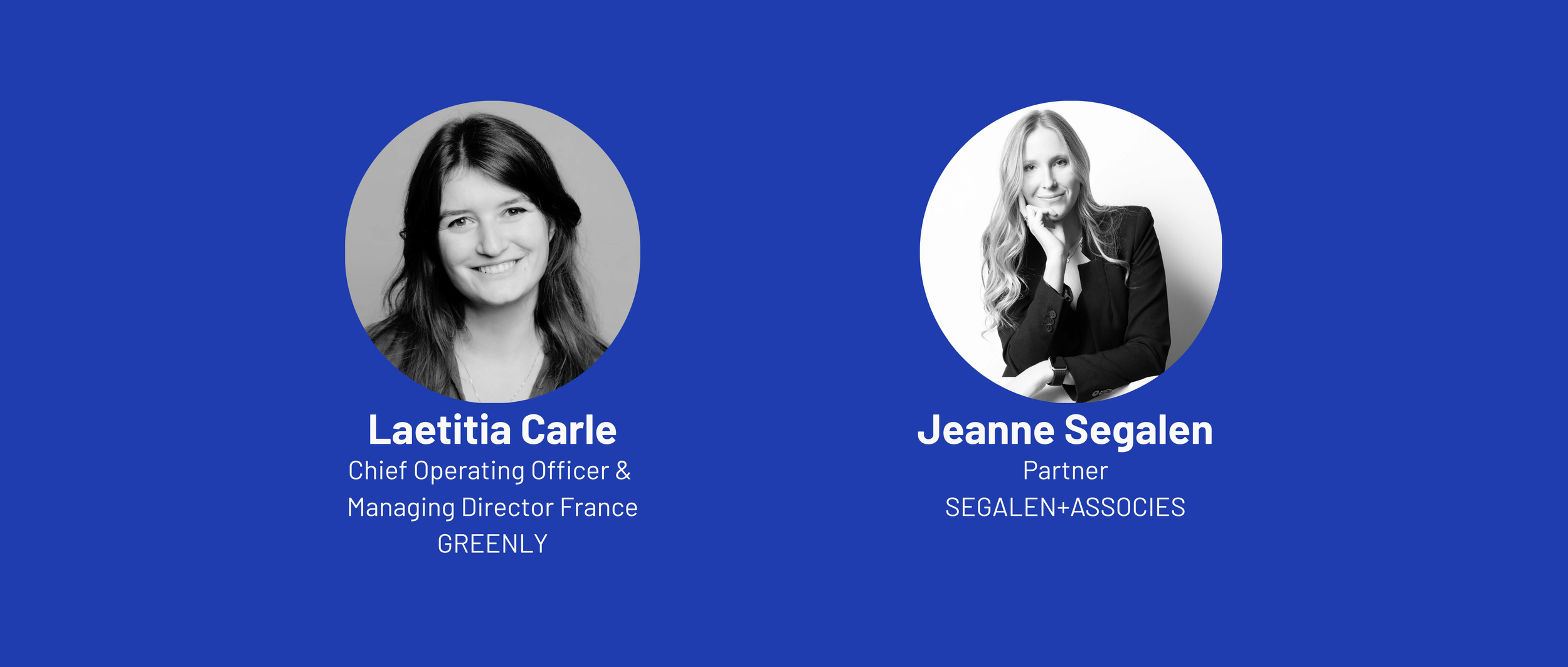
3 questions for Laetitia Carle, COO and Managing Director France at Greenly
Laetitia Carle joined Greenly in 2022 following an early career in investment banking. She has since supported the structuring and scaling of this French climate tech company, which now operates across Europe and the United States.
In a fast-growing yet increasingly mature sector, she shares her perspective on the dynamics at stake: market consolidation, the evolving role of regulation, and how organisations are transforming in response to climate challenges.
How do you assess recent developments in the climate tech sector and the challenges of scaling?
Since 2019–2020, the sector has seen an explosion in the number of players, with hundreds of start-ups entering the space. At Greenly, we made an early shift towards a B2B model in 2020, which helped shape our growth trajectory.
After several years of very rapid expansion, often at any cost, the market has entered a more demanding phase, with tighter access to funding, lower valuations, and a clearer distinction between stronger and weaker players. In this highly fragmented landscape, a wave of consolidation is now beginning to emerge.
Our differentiation has been our ability to quickly build a substantial client base. We made a choice that may initially have seemed counter-intuitive: focusing primarily on SMEs. This allowed us to reach critical mass, around 1,000 clients, while gathering significant data and developing deep expertise across a wide range of industries.
This approach enabled us to develop a highly sophisticated product, with a more vertically structured, industry-specific focus, and to train our algorithms to deliver greater automation and personalisation. It now allows us to serve mainly mid-sized companies, and increasingly large corporates, with an offering suited to more complex environments.
In this context, our positioning, combining rapid growth, profitability, and a broad client base, places us in a strong position to play an active role in the ongoing consolidation of the market.
In a context of significant regulatory uncertainty, how are companies balancing compliance with strategy?
The regulatory landscape is in constantly changing at the moment. Before and after Covid, there was a clear and steady trend towards increasing regulation.
More recently, two developments could have dampened market momentum: the election of Donald Trump at the end of 2024, and in 2025 the European Commission’s discussions around the “Omnibus” packages, which raised questions about the CSRD and non-financial transparency. These signals have mainly created confusion for companies, many of which had already put structures in place and committed investment. Even so, corporate engagement has not slowed. Efforts have instead been refocused on what directly supports the business: resilience, risk management, and energy performance.
We are also seeing a shift in the narrative, particularly in the United States. There is less emphasis on ESG or sustainability, and more on performance and resilience. Following Donald Trump’s election, we expected a slowdown in our activity; in fact, our US market is now our fastest growing.
At the same time, topics such as artificial intelligence illustrate these tensions clearly. AI can accelerate the energy transition, yet it is also energy-intensive, raising questions about the development of more efficient, lower-impact systems.
Ultimately, the momentum continues to be driven largely by business considerations: climate strategy is becoming a matter of competitiveness, market access, and long-term resilience.
What, in your view, are the key conditions for successfully delivering a sustainable transformation within organisations?
The most critical factor remains leadership commitment. A climate transformation cannot be driven by an ESG function alone; it needs to be embedded across the entire organisation and led from the top.
It is a transformation comparable to digital transformation, affecting every department. At Greenly, this is reflected in the fact that the entire executive committee is tied to our climate performance. For instance, the CFO may have targets linked to supplier engagement.
More broadly, our core business directly contributes to decarbonisation. This principle needs to be built into the company’s objectives and performance metrics.
We are also seeing a shift in skill sets, with the emergence of more technical expertise, particularly in areas such as climate engineering and risk management. More than a shortage of talent, the real challenge lies in structuring organisations so that these capabilities can be fully leveraged, working in close alignment with other business functions.