
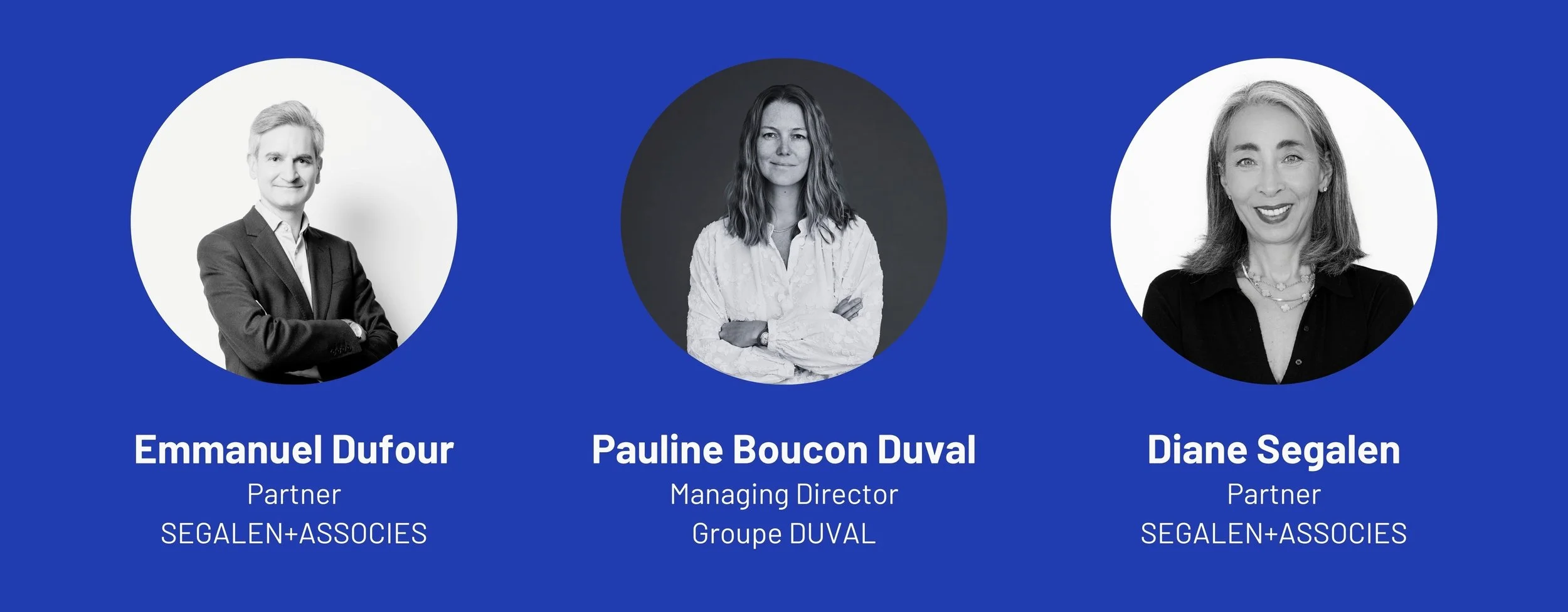
3 questions to Pauline Boucon Duval, Managing Director of Groupe Duval
QUESTION 1 – Investment thesis and generational transition
The Duval Group has grown from real estate development into an ecosystem worth over one billion euros, spanning tourism, golf, Africa, and startups and more. How would you describe the investment thesis today - not the institutional version, but the one you actually use when making decisions?
Our actual investment thesis is not merely institutional; the Group’s mission serves as our filter, our strategic touchstone. It forms our strategic backbone: an independent, entrepreneurial family-owned group dedicated to serving local communities and fostering better social cohesion.
It also reflects a strong strategic conviction: there can be no sustainable financial performance without non-financial performance. Investing in ESG today to generate impact means building a competitive advantage for tomorrow, ensuring we remain at the forefront of commitment.
This mission allows us to align all our activities - a particularly important step given how much we have diversified. In practical terms, every opportunity is evaluated based on its alignment with our values, our ambition, and our impact.
Since the Group was founded in 1994, approximately every six years we have entered a new strategic phase, expanding into new businesses while remaining true to our entrepreneurial DNA. We also regularly ask ourselves a question that is just as important: are we still the right shareholder? Although we have never sold an asset, we carry out strategic reviews to ensure that every business remains relevant within the Group and that we continue to be the right long-term owner.
When considering a new sector or a potential acquisition, what are your three non-negotiable criterias?
For us, the three non-negotiable criteria are:
1. Trust in the people involved: the founders' vision and personality, which are decisive for success and alignment with our values;
2. The project's entrepreneurial culture: an essential foundation and the project's very DNA. And, of course, potential synergies with the Group to help us reinvent ourselves - specifically, alignment with our strategic development priorities;
3. Purpose, as well as societal and environmental impact.
And with the generational shift from your father to your brother and yourself, what are the implications and new directions?
Éric founded this group in 1994 - a self-made entrepreneur who learned the ropes on construction sites, building upon the family’s legacy in the construction industry. He had a builder’s vision: to build for the long term. Today, the Group employs 6,000 people across more than 20 countries, with a turnover of nearly one billion euros.
With the arrival of Louis-Victor and myself, the company my father founded has effectively become an intergenerational family venture: taking the best of both worlds and staying fully aligned with the challenges of our time, without forsaking the strengths that made us who we are.
Achieving ‘Mission-Driven Company’ status in 2024 stands as a testament to this proactive succession. This mission-driven status did not replace the family DNA; rather, it revealed and protected it - aligning it with the societal challenges of today and tomorrow.
Beyond governance, we have also naturally divided our responsibilities. Louis-Victor focuses primarily on Africa, financial services and shorter-term development opportunities, while I oversee our long-term real estate strategy as well as operational businesses such as hospitality and golf. It allows each of us to contribute according to our strengths while pursuing a shared vision.
QUESTION 2 – The business angel / Groupe Duval boundary
You are a highly respected business angel in France, and you invest alongside your work with the Group. How exactly do you draw the line between the two?
My desire to invest was sparked by an early experience in private equity - specifically, pivotal encounters with entrepreneurs. More broadly, as CEO of Groupe Duval, I quite quickly wanted to pay forward the opportunities I had been given.
I have always deeply admired those who take risks and build things. What interests me about this process is, above all, dedicating time and sharing in a collective journey - investing both capital and personal commitment.
Since 2014, we have had the pleasure of supporting around forty startups, from Lydia to XXII, with a particular interest in female founders. What attracts me most is meeting entrepreneurs. I have enormous admiration for people who take risks to build something new. Having benefited myself from exceptional mentors, starting with my father, but also the Belgian shareholders who helped structure the Group, I feel a responsibility to give something back to the next generation of entrepreneurs.
Do you invest personally first and then propose the opportunity to the Group, or is the process more fluid? At what point does a deal you are personally championing become a Duval deal?
They are two distinct channels, driven by very different investment strategies. Groupe Duval invests exclusively by taking majority stakes, whereas I consistently take minority stakes in startups.
However, I make sure to create bridges between the startups and the Group. We make our support functions, industry experts, networks, and resources available to them. In return, these collaborations push us to challenge our own practices and boost our agility.
Whenever possible, we also mobilise the Group's HR, legal and tax expertise to support the companies we invest in. The relationship goes well beyond capital: it is about sharing experience and creating long-term value together.
Which sectors or types of companies guide your choices?
We naturally focus on innovation - specifically startups that can challenge us regarding the various transitions we face, particularly the environmental and technological ones.
An example of an AI startup: XXII.
QUESTION 3: Governance: balancing family and external management on the Executive Committee
The Executive Committee comprises a mix of family members and external managers. How do things work when the family members aren't aligned?
What role do the external members play? If you had to define the profile of a leader ‘compatible’ with the Duval culture, what are the two or three traits that really make the difference?
So far, it has always happened quite naturally: there are three of us family members, and decisions are made based on a majority vote.
In practice, things are very straightforward. If we disagree, my father still has the final say, which has always enabled us to move forward quickly.
The non-family executives play a key role: they are there to challenge us. We didn't recruit them to validate our existing beliefs, but to bring a different perspective, challenge us, and flag issues when they think we’re heading in the wrong direction. This demand for debate is an integral part of our culture. We have built an environment where critical thinking and freedom of speech are encouraged and expected.
Our Executive Committee is deliberately broad because our businesses are highly diversified. We need people with different expertise who are willing to challenge our assumptions. Healthy debate is essential, but it must ultimately lead to a shared vision built on mutual listening.
Furthermore, we selected a highly entrepreneurial ‘Mission Committee’ that aligns with our values and helps us evolve in other areas of the business. This formal body, distinct from the Executive Committee, provides an ongoing external perspective: challenging us while also highlighting our distinctive strengths.
The members of our Mission Committee embody a forward-looking vision and a deep commitment to purpose:
· Bris Rocher, drawing on his Group’s pioneering experience;
· Camille Vever, who reinvented a historic family business by making its mission the starting point;
· Thibault Lamarque, CEO of Castalie, a company built around a core purpose from day one;
· And finally, Nathalie Sarel, Managing Director of Sustainable Banking at Crédit Agricole.
Ultimately, the traits shared by the Group’s leaders are:
o An entrepreneurial spirit and curiosity;
o Humility and the ability to listen, fostering a mindset of continuous improvement;
o And ambition - believing that "anything is possible," because dreaming small takes just as much time as dreaming big.
Preserving our entrepreneurial culture also means encouraging every leader to think like an entrepreneur. Even functions such as legal or HR are expected to take ownership, innovate and contribute to the Group's development. We also work systematically in pairs and maintain succession plans for every key position to ensure long-term continuity.